
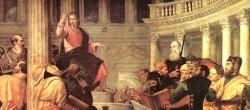

Christ among the Doctors of the Law


Monday, January 17, 2011

Why Canon 277 § 3 does not allow bishops to exempt clerics from the obligation of continence

Canon 277 § 3 states: “The diocesan bishop is competent to establish more specific norms concerning this matter [i.e., the perfect and perpetual continence of clerics, per Canon 277 § 2]” and to pass judgment in particular cases concerning the observance of this obligation.”

In
my Studia article, I twice (see pp. 151 and 168) mention Canon 277 § 3, but only to say that it is of minimal importance in determining whether an obligation of perfect and perpetual continence is imposed on clerics under canon law. The audience for whom I wrote the article would have regarded my observation on 277 § 3 as non-controversial and would have moved on to the next point.

A number of bloggers, however, seem to think that Canon 277 § 3 is very important to this question, and indeed, that it is the Achilles heel of my argument. It is neither. At the risk of running down a rabbit trail, I will point out just two of the reasons why Canon 277 § 3 does not avail those who argue that married clerics in the West are not obligated to continence.

1. Canon 277 § 3 authorizes bishops to make specific rules which, given local circumstances, would support clerics in living in continence. To argue that local legislation can exempt clerics from a universal requirement is to turn the whole idea of local adaption of rules on its head. This is clear, I suggest, not only from common sense, but from the acknowledged predecessor norm of Canon 277 § 3, namely 1917 CIC 133 § 3, which stated “The judgment about retaining or frequenting women, even those who commonly fall under no suspicion, in particular cases where scandal is possible or where there is given a danger of incontinence, belongs to the Ordinary of the place, who can prohibit clerics from retaining or frequenting [such women].” Nothing in this norm remotely suggested that bishops could exempt clerics from the obligations in regard to chastity. Instead it allowed bishops to specify certain conduct that, like a fence around the law, must be avoided lest the fundamental obligations be endangered.

Examples of such local legislation were common in pre-conciliar canonistics, e.g., diocesan laws prohibiting priests from giving rides in their cars to single women, or telling them to avoid nightclubs, and so on. Local legislation was intended to protect the basic obligations, not to relax them.

2. Those who argue that Canon 277 § 3 allows bishops to relax the obligation of continence should think about what they are implicitly acknowledging: namely, that, if some bishops can relax the obligation thereby, others can impose it. But that would result in disciplinary chaos, of course, if say, the Archdiocese of San Francisco imposed continence on married clerics while across the bay the Diocese of Oakland exempted them from it. What would happen then?

Canon 277 § 3 is, as I have said, irrelevant as to whether the obligation of perpetual continence applies to married clerics in the Western Church. And that is the question before us. + + +

Update, 17 Jan 2011: The implications (or non-implications, as the case may be) of the 1998 joint dicasterial instruction (that's an important word here) on the diaconate, which document indeed contains the phrase “a certain continence” as an expectation for married deacons, is discussed in my Studia article at pp. 172-174...and now in more detail here.

Monday, January 24, 2011

Why "Anglicanorum coetibus" does not control one's reading of Canon 277

Some have wondered whether anything in Anglicanorum coetibus, the document by which former Anglican faithful are coming into full communion with the Catholic Church, persuades me to retreat from or abandon my argument that Canon 277, etc., requires clerics in the West, even married ones, to observe perfect and perpetual continence. I think not.

Three documents inform one’s understanding here: the apostolic constitution
Anglicanorum coetibus (4 Nov. 2009), the Complimentary Norms issued by Congregation for the Doctrine of the Faith the same day, and an “official commentary” on the constitution by the esteemed canonist Gianfranco Ghirlanda of the Gregorian University. Two points emerge from these sources.

First, none of these documents even mentions the clerical obligation of continence as set out in Canon 277, so any claim that they obrogate from the express language of Canon 277 can be offered only ex silentio. I believe, however, that the weaknesses of ex silentio arguments against clerical continence are apparent to anyone who reads
my analysis of Canon 277; those observations apply here as well.

Second, and even more decisively, while an 'apostolic constitution' is the highest form of legislative document used by the Church (see Morrisey, Papal and Curial Pronouncements [1995] at 14-17) such a document must be interpreted in accord with the general principles of canon law (
cc. 16-21) including: applying it to matters it intends to cover, and declining to apply it to matters it does not intend to cover. Anglicanorum and its Complementary Norms, by their repeated and express terms (passim), apply only to former adherents to the Anglican communion, and to no one else. Nothing in Ghirlanda’s commentary remotely suggests otherwise. Therefore, regardless of how Anglicanorum might (or might not) impact former Anglicans in this area, it cannot control arguments concerning the operation of Canon 277 for any other clerics in the Church.

I have some other comments on Anglicanorum, but these two suffice, I think, to address the question presented to me.

Friday, October 28, 2011

Responses to recent assertions concerning Canon 277 and clerical continence

The 2011 issue of Roman Replies and CLSA Advisory Opinions, published by the Canon Law Society of America, contains two items of interest to those following the discussion of clerical continence under Canon 277. The first, offered as a “Roman Reply”, is a brief letter from Abp. Francesco Coccopalmerio, president of the Pontifical Council for Legislative Texts. The second is an advisory opinion by Rev. William Woestman, omi, now with the Archdiocese of Chicago. Both gentlemen disagree with my interpretation of Canon 277.

Now, I say “my interpretation” advisedly. I am not alone in reading Canon 277 as imposing an obligation of continence on all Western clerics, married or celibate, though I am presently the author most engaged in the public debate about the sharp discrepancy that has set in between the text of and tradition behind Canon 277 on the one hand, and the lived experience of tens-of-thousands of Western married clerics and their wives on the other. Also, my interpretation does not, contrary to how it is usually presented by opponents, direct a single specific resolution, but instead admits of various resolutions.

In any case, Abp. Coccopalmerio’s letter and Rev. Woestman’s opinion need reply, the first, because it will inevitably be mistaken for something akin to Roma locuta causa finita (which it quite clearly is not), and the second because it is a rare example of a qualified scholar trying to deal with this complex question in a competent manner. I disagree with the conclusions contained in both documents, but Rev. Woestman’s, especially, raises some points that will allow me, I think, to show how the question of clerical continence in the Roman Church remains very much an open one.

My reply to Abp. Coccopalmerio's letter is here; that to Rev. Woestman's opinion is here.

Saturday, January 15, 2011

Canon 277 and clerical continence in the Roman Church

My article “Canonical considerations on diaconal continence”, originally published in Studia Canonica 39 (2005) at 147-180, and some introductory observations, are now available on my website, here.

1983 CIC 277. § 1. Clerics are obliged to observe perfect and perpetual continence for the sake of the kingdom of heaven and therefore are bound to celibacy which is a special gift of God by which sacred ministers can adhere more easily to Christ with an undivided heart and are able to dedicate themselves more freely to the service of God and humanity. § 2. Clerics are to behave with due prudence towards persons whose company can endanger their obligation to observe continence or give rise to scandal among the faithful. § 3. The diocesan bishop is competent to establish more specific norms concerning this matter and to pass judgment in particular cases concerning the observance of this obligation.

Update, 16 Jan 2011: I attempted to post the following comment over at Deacon's Bench, but it was rejected as "spammy". Oh well, here goes.

Dcn. Greg Kandra, webmaster of the respected “Deacon’s Bench” blog, asks: “Does anyone seriously think that tens of thousands of married deacons — not to mention the hundreds of married priests — are now suddenly going to commit to stop having sex? If that’s the case: gentlemen, ask your wives to add more saltpeter to your diet.”

I assume Dcn. K’s read my article, so he knows that “suddenly stop[ping] having sex” is not my suggestion to Western married clerics. His tendentious phrasing, therefore, can only be rhetorical, in which case, though, he is implying that I do, in fact, hold that married clerics must “suddenly stop having sex”. That's disappointing, coming from one of obvious good sense on so many other topics; worse, it's distracting from the real discussion that needs to take place.

Canon 277 (and the immemorial tradition behind it) either means what I say it means, or it doesn’t. My arguments are open to rebuttal, but I don’t think they should be subjected to ridicule. If a sexually active (married) diaconate, and a fortiori, a sexually active (married) priesthood is, in the end, a contradiction of canon law and Western tradition—and neither I nor Dcn. K get to decide that—then only two choices will ultimately be available: (a) change the law and abandon the tradition, or (b) accept the law and observe the tradition, in which case, obviously, reasonable accommodation must be made for the thousands of men who were ordained without being advised of the requirements of their state. Those are important questions, not trivial ones.

In short, I welcome informed discussion of my thesis and its implications, but I hope we won’t have to spend too much time telling people to ignore quips about "saltpeter" and such along the way.

Update, 16 January 2011: Dcn. Kandra has updated his post, here.

Thursday, November 17, 2011

Sandro Magister on clerical celibacy and continence

Sandro Magister’s recent column on the debate over clerical celibacy and continence is worth a careful read. While continence is distinguishable from celibacy, of course, it is closely related to it in terms of history, theology, and canon law. I and others argue that continence is the primary good protected by Canon 277 (and by the unbroken line of legal provisions leading up to it) and that celibacy, although truly “a special gift from God” in its own right, is ordered to continence. But all of this is discussed elsewhere.

Here I limit myself to three remarks on Magistro’s essay.

Magister rightly names the Jesuit priest Christian Cochini and Alfons Cdl. Stickler as among major scholars refuting the received history that clerical celibacy/continence was optional for many centuries in Church life, that the West only gradually imposed these weighty obligations on its clergy, and that the East maintained the original institution of married clerics exercising their conjugal rights. There are other scholars pursuing these lines, of course, including the priests Stefan Heid, Donald Keefe, and Thomas McGovern, and some recent doctoral students.

I thought it a bit odd that Magister cited Eastern canon law on married clerics, but not Roman canon law, despite the fact that Western law (c. 277) expressly preserves the value of clerical continence (although, of course, that value has not been inculcated in formation programs for married clergy).

As for whether there are quite as few scholars pursuing the continence issue as Magister suggests, I grant that relatively few scholars are weighing in either way on this matter (most preferring, perhaps, to let only the most serious researchers wade into such deep and turbulent waters), but would add that at least some of those trying to have their views in behalf of clerical continence aired have run into problems over the years getting their works into print. In any case, that is changing in recent times and awareness that these serious questions are afoot is widespread now.

Finally, a reminder that, while reform in the Church is constant, it happens slowly. +++

ps: Readers know of my appreciation for those doing translations, so, a special note of thanks to Matthew Sherry for his consistently fine work in bringing Magister into English!

Monday, March 24, 2008

Canon 277: "celibacy" and "continence" are different things

The sad case of Zimbabwe Archbishop Pius Ncube, who was the only credible opponent of Thug-in-Chief Robert Mugabe, is the occasion to try to remind people that Canon 277 of the Johanno-Pauline Code establishes two related but distinct obligations for clerics in the Western Church, namely, celibacy and continence. As an archbishop, Ncube was bound both to refrain marriage (celibacy) and to refrain from sexual relations with anyone (continence). Ncube has admitted to having sex with a woman (a married woman, as it happens); therefore he has admitted to violating the law of continence; he has not attempted marriage with this woman, and therefore he has not violated his promise of celibacy.

Nevertheless, every single press report I have seen on this case alleges that Ncube violated his promise of celibacy! Not one of them claims he violated the law of continence. This is the opposite of what they should be saying.

Friday, October 07, 2011

Regarding Dcn. Duderstadt’s remarks on Canon 277 and clerical continence

Deacon Peery Duderstadt’s essay in the current issue of Chicago Studies, “A Modest Proposal”, attempts to reply to an article I wrote last year for Chicago Studies, “Diaconal Categories and Clerical Celibacy”. Duderstadt’s work is poorly conceived and very poorly executed. While it would be tedious to discuss all of the flaws in his essay, I feel that some response is in order. My criticism of Duderstadt’s essay must, I fear, be blunt. I have no desire to embarrass anyone, of course, but it might be instructive for others to see, from time to time, just what kind of ineptitude is wont to present itself, even in respected venues, as informed refutation of my (and others’) interpretation of the law.

My three-page Memorandum regarding Dcn. Duderstadt’s remarks on Canon 277 and clerical continence is here: http://www.canonlaw.info/PDF-Duderstadt.pdf.

Wednesday, August 24, 2011

Further to my discussions of Canon 277

A misinterpretation of a mistranslation of Vatican II’s Presbyterorum ordinis 16 lends itself to use against the clerical obligation of perfect and perpetual continence that I have argued is contained in Canon 277. I address the matter in Edward Peters, “A note on some misapplications of Presbyterorum ordinis 16”, Fellowship of Catholic Scholars Quarterly 34/2 (Summer 2011) 31-33, available in PDF here. For access to all of my published materials on this question, and for links to several other authors, see this page.

Tuesday, January 18, 2011

Debating complex points of law is hard enough; having to repudiate false quotations is too much

There are, I need hardly say, far too many responses to my article on clerical continence for me to respond to them all, or even to respond just to those deserving of some reply. John Martens, writing over at America, actually read my original article (which separates him from the vast majority of critics). But his treatment of this matter is wholly unbecoming of its importance, or of America magazine's website.

Marten's chief criticism of my work is that I did not write an article I never claimed to have written, namely, a Scriptural commentary on married life and conjugal relations. Says Martens: “
There is no discussion anywhere in [Peters'] article on biblical teachings regarding sex and marriage. Although Jesus’ teachings on sex and marriage might be alluded to in this article, they are not cited once in the body of the paper or in the footnotes. I could not locate allusions to Paul’s writings at all in the body of the paper or in the footnotes. . .” Major flaws, per Martens.

If that is his criticism, though, surely I may reply that Martens did not write much of a canonical response to my canonical article. If Martens wants to argue that canon law is an insufficient rubric by which to assess Christian marriage, I might agree and engage the topic, but we all would recognize that we were then talking about what Martens wants to talk about, not about what I brought up for discussion.

I don’t consider myself a theologian, and I certainly don’t boast Scriptural credentials, but I am a pretty good canon lawyer, and the case I have made against the exercise of conjugal rights by clerics in the Western Church is plainly canonical. Naturally, I think the Code’s provisions in this area (chiefly in Canon 277) rest on solid theological foundations (foundations that invoke the theology of Orders as well as of Matrimony, which point Martens never seems to recognize; but he is in large company there); but I do not offer, or pretend to offer, a theological, let alone a Scriptural, case for clerical continence, I offer a canonical one. If my canonical arguments are flawed, by all means, show me how. But if Marten’s complaint is my lack of theological argumentation, then I can only invite him to consult Stickler, Chochini, Cholij, and so on. They can offer him fitter fare.

This general point aside, however, there are some serious, specific problems that need to be addressed. Let me start with the most grave.

1. Martens writes: “[T]he sort of continence one is called to is dependent upon whether one is married or not. Indeed, that is the case in the 1917 CIC Code, which Peters cites: ‘Continence is different from chastity; to be chaste is to forego sexual relations; to be continent is to have sexual relations in their properly ordered sphere of conduct’ (159). That strikes me as precisely what is taking place in the practice of the permanent diaconate, though in his first footnote Peters states that ‘throughout this article continence is understood in a canonical (as distinguished from a philosophical) sense to be the complete refraining from sexual intercourse’ (147). Yet ‘complete refraining from sexual intercourse’ is not the same as ‘to have sexual relations in their properly ordered sphere of conduct’ (159). Either Peters forgot what he wrote on page 159 or he chooses to ignore it.”

Martens’ assertion is a grave violation against academic honesty.


The quote that Martens attributes to me, “Indeed, that is the case in the 1917 CIC Code, which Peters cites: ‘Continence is different from chastity; to be chaste is to forego sexual relations; to be continent is to have sexual relations in their properly ordered sphere of conduct’ (159).’”, and which Martens later claims I conveniently forgot or chose to ignore, is a complete fabrication. I wrote no such thing, on page 159 or anywhere else. I think, moreover, that the ersatz quote is wrong in its substance, and I would never have written so sloppily on a central issue in my thesis. So, I did not forget or ignore what I allegedly wrote on page 159. I simply never wrote it, but thanks to Martens, I now have to spend my time disowning a goofy assertion that I never made. I do not hesitate to say that I am angry at this shabby stunt. And while I do not know Martens from Adam, I expect America magazine to take action in response to this kind of authorial misconduct.

2. I find Martens’ armchair attempts to psychoanalyze my motives in writing the study improper and ad hominem. Martens asks “What then bothers Ed Peters about the current practice of the married permanent diaconate in the Roman Catholic Church?” Later: “The overarching question for me, especially in light of the actual practice of the Church with respect to permanent deacons and the biblical teaching of Paul, is what is at stake in this argument for Ed Peters? What’s the point? What is so troubling about married permanent deacons having sexual relations with their wives? What Ed Peters argues conjures up the ghosts, past, present and future, of a Church that has trouble with sex, even in its properly ordered place.” And still later, “[I]t is not the Church that has a problem with married permanent deacons having sex with their wives, it is Ed Peters.”

Why does Martens assume that I must be bothered? Or that I am troubled? Or that I am bent on conjuring up ghosts? Who is Martens to say that I have a problem with this or that? Why can’t a canon lawyer, who finds what appears to be a major discrepancy between the text of the law and the practice of a large and important group of faithful on an important point, simply find that situation a worthy topic for his attention? Why must one’s scholarship be driven by the need to quell hidden neuroses? Let me say, mine isn’t. I don’t presume to speak for Martens.

3. Finally, after belittling my one attempt at a Biblical allusion (see why non-Scripture scholars are so afraid to use the Bible?), Martens states: “I believe that Ed Peters sees himself either as the High Priest Hilkiah who found the lost book of God’s law and delivered it to King Josiah or as King Josiah calling the people back to the Law, in which the King destroyed the idolatrous shrines, killed some of the pagan priests and returned the people back to the true law of God. Either way it indicates that he feels the Church has followed an idolatrous or pagan path in allowing married permanent deacons to have sex with their wives.”

To make such an accusation is, in fact, to accuse one of denying the indefectibility of the Church. I hold no such belief, and pray God I would never succumb to such. As for whom I see myself as, Martens’ impertinent speculation here shows how little he knows of me. I see myself as Ed Peters. But, if forced to see myself in the story, I suppose I would see myself as those lowly laborers whom I imagine finding the text of the law in the basment and who said to themselves, “Hey, this looks pretty important; we’d better pass it along to folks who know what they are doing.”


Which I have done.

Monday, January 17, 2011

Some thoughts on Dcn. Ditewig's comments on diaconal continence

I must be jinxed. I’m no nubbie when it comes to the internet and blogging, but I am constantly stiffed when I try to post replies on other blogs using Google stuff. And I always try first to reply in the context in which folk’s remarks are made. Anyway, skunked again, this time, when trying to post some thoughts on Dcn. Bill Ditewig’s thoughtful reactions to the diaconal continence debate unfolding around us. So, in lieu of posting over at Ditewig’s Deacons Today, I’ll offer my comments here . . .


Hello Dcn. Ditewig. Thank you for a real attempt to think through these issues. There are some points that, although they are in my Studia article (and you might revisit it) could do with some underscoring here [on your website].

1. The obligation of continence is express in the law (c. 277), and the disappearance of the proposed exception for married deacons was not a typographical accident. At least 30 canons of the 1982 draft underwent significant textual amendment at the hands of JP2, and no one regards any of those changes as accidental. They were deliberately made by the pope. See the introduction to my Incrementa in Progressu (2005). Indeed, the deliberateness of the removal of the exemption for married deacons in c. 277 is recognized by EVERY canonist who has considered the issue (even those who disagree with my conclusions on other grounds). Thus the ‘silence’ you suggest regarding the proposed exemption for deacons speaks volumes.

2. Eastern law is not an issue here. I am talking about the law and tradition of the West. I don’t know why so many people assume that, where East and West disagree, the East must have it right (that is not your claim, I know); but it’s a debate I don’t enter, or need to enter. I am talking about Western canon law.

3. You have the priority of the related-but-distinct obligations of continence and celibacy reversed. Consider, all unmarried people are bound to continence, no? But most of them are not bound to celibacy, right? --See n. 4 below.-- So the obligations are distinct. Mary and Joseph were not celibate, they were continent. Celibacy is, to be sure, the context in which most Western clerics will live out their holy continence, and it (celibacy) is recognized as "a special gift of God", but even for those clerics who are not celibate, western canon law and tradition still expect of them continence. That is my claim, at least, based on the plain text of c. 277.

4. Small point: re yours that celibacy can be defined as "the state of being unmarried." Hmmm. I would rather say, “the willed state of being unmarried”, to distinguish “celibates” from folks who just happen to be single.

5. Your definition of continence as “abstinence from sexual activity, either permanently (such as in the case of a professed religious who vows such continence) or temporarily”, is ok as far as it goes, but the West, unlike the East, has never used continence in any “temporary” manner when it comes to clerics. For the West, clerical continence is always regarded as absolute and life-long from the moment of ordination.

6. I addressed Fr. Provost’s canonical arguments expressly. Just so people know.

7. Re VC2’s 'silence' re continence, yours here is more of a theological, even a prudential, argument, and personally, I might agree that VC2 maybe could have said something. But, in default of their addressing the matter, the point falls to me, for the reasons I set out at length in the article, chiefly, that the prospect of non-continence among clerics was never even a thought in the Council Father’s heads, and no one felt constrained to restate the unbroken and unexceptioned assumptions of law and tradition. Even Paul VI, as you know from having read the article, adopted the then-current discipline for all clerics when he reorganized the diaconate, and that discipline was, absolutely beyond any question, one of absolute continence for all married men in holy orders.

Again, thank you for treating the arguments here [on your website] so respectfully. Once we get clear on what the laws says (and there are many who need convincing yet) we’ll be in a better position to reflect together on what the law should say, or on how to bring the married diaconate (and presbyterate) into full accord with the law, in a reasonable way.

Best, edp.