
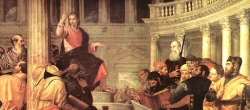

Christ among the Doctors of the Law


Monday, January 17, 2011

Some thoughts on Dcn. Ditewig's comments on diaconal continence

I must be jinxed. I’m no nubbie when it comes to the internet and blogging, but I am constantly stiffed when I try to post replies on other blogs using Google stuff. And I always try first to reply in the context in which folk’s remarks are made. Anyway, skunked again, this time, when trying to post some thoughts on Dcn. Bill Ditewig’s thoughtful reactions to the diaconal continence debate unfolding around us. So, in lieu of posting over at Ditewig’s Deacons Today, I’ll offer my comments here . . .


Hello Dcn. Ditewig. Thank you for a real attempt to think through these issues. There are some points that, although they are in my Studia article (and you might revisit it) could do with some underscoring here [on your website].

1. The obligation of continence is express in the law (c. 277), and the disappearance of the proposed exception for married deacons was not a typographical accident. At least 30 canons of the 1982 draft underwent significant textual amendment at the hands of JP2, and no one regards any of those changes as accidental. They were deliberately made by the pope. See the introduction to my Incrementa in Progressu (2005). Indeed, the deliberateness of the removal of the exemption for married deacons in c. 277 is recognized by EVERY canonist who has considered the issue (even those who disagree with my conclusions on other grounds). Thus the ‘silence’ you suggest regarding the proposed exemption for deacons speaks volumes.

2. Eastern law is not an issue here. I am talking about the law and tradition of the West. I don’t know why so many people assume that, where East and West disagree, the East must have it right (that is not your claim, I know); but it’s a debate I don’t enter, or need to enter. I am talking about Western canon law.

3. You have the priority of the related-but-distinct obligations of continence and celibacy reversed. Consider, all unmarried people are bound to continence, no? But most of them are not bound to celibacy, right? --See n. 4 below.-- So the obligations are distinct. Mary and Joseph were not celibate, they were continent. Celibacy is, to be sure, the context in which most Western clerics will live out their holy continence, and it (celibacy) is recognized as "a special gift of God", but even for those clerics who are not celibate, western canon law and tradition still expect of them continence. That is my claim, at least, based on the plain text of c. 277.

4. Small point: re yours that celibacy can be defined as "the state of being unmarried." Hmmm. I would rather say, “the willed state of being unmarried”, to distinguish “celibates” from folks who just happen to be single.

5. Your definition of continence as “abstinence from sexual activity, either permanently (such as in the case of a professed religious who vows such continence) or temporarily”, is ok as far as it goes, but the West, unlike the East, has never used continence in any “temporary” manner when it comes to clerics. For the West, clerical continence is always regarded as absolute and life-long from the moment of ordination.

6. I addressed Fr. Provost’s canonical arguments expressly. Just so people know.

7. Re VC2’s 'silence' re continence, yours here is more of a theological, even a prudential, argument, and personally, I might agree that VC2 maybe could have said something. But, in default of their addressing the matter, the point falls to me, for the reasons I set out at length in the article, chiefly, that the prospect of non-continence among clerics was never even a thought in the Council Father’s heads, and no one felt constrained to restate the unbroken and unexceptioned assumptions of law and tradition. Even Paul VI, as you know from having read the article, adopted the then-current discipline for all clerics when he reorganized the diaconate, and that discipline was, absolutely beyond any question, one of absolute continence for all married men in holy orders.

Again, thank you for treating the arguments here [on your website] so respectfully. Once we get clear on what the laws says (and there are many who need convincing yet) we’ll be in a better position to reflect together on what the law should say, or on how to bring the married diaconate (and presbyterate) into full accord with the law, in a reasonable way.

Best, edp.

Tuesday, October 31, 2006

Does Fr. Gravel really have permission to hold office?

LifeSiteNews is reporting that the Canadian priest Raymond Gravel, notorious for his voiciferous disagreement with Church teaching on just about every major social issue, has obtained permission from his bishop to run for national governmental office. This claim, however, seems impossible to reconcile with sound canon law.

Under the 1983 Code, Catholic priests are flatly prohibited from holding governmental office: Canon 285.3 plainly states "Clerics are forbidden to assume public offices which entail a participation in the exercise of civil power." The legislative history of this norm makes obvious the Legislator's intent to eliminiate any exceptions to this rule. See Peters, Incrementa in Progressu at 234.

Unlike those situations where a priest might be given permission to serve as an agent for lay persons or as co-signer of a loan, or to hold office in unions or political parties (see 1983 CIC 285.4 and 287.2), there is no provision in Canon 285 for bishops to grant a priest permission to hold governmental office. None. Presbyteral council "approval" of any alleged "permission" is completely irrelevant.

The Holy See could, of course, grant permission for a priest hold governmental office, but there is not the slightest chance that Rome would do anything to enable this cleric to spread his kind of scandal at the national level.

Prescinding from other canonically confusing aspects of this case, the only theory by which Fr. Gravel might have been given episcopal permission to seek national office would be in virtue of a dispensation from disciplinary law under 1983 CIC 87 and 90. The standard canonical authors recognize such a possibility, but when commenting specifically on the prohibition against priests holding major governmental office, they stress how low is the likelihood that such permission would ever "contribute to the spiritual good" of those under a bishop's care. In Fr. Gravel's case, of course, the assertion that such permission might serve a "spiritual good" would be laughable.

In short, it seems that someone has either thoroughly confused Canon 285 with Canon 287, or has deeply disregarded Canons 87 and 90. Either way, this situation needs correction.

(A minor clarification on the LSN report: the canonical prohibition against priests holding governmental office did not start with the Drinan case in the USA; it was part of the Pio-Benedictine Code (see 1917 CIC 139), though Fr. Drinan's conduct in office through the 1970s certainly helped galvanize renewed enforcement of the norm.)

Same Day Update: Another Canadian priest, Fr. Thomas Dowd, writes that Fr. Gravel's "permission" to hold secular office was contingent upon his accepting certain restrictions on his ministry. Those restrictions seem like some of the "other canonically confusing aspects of this case" I referred to above. Interesting, but it doesn't change my analysis. There are no conditions upon which episcopal "permission" to hold governmental office can be given to a priest. Again, if this is not a dispensation case, as doubtfully valid as that dispensation would be, it's nothing.

Updates, November 1: Skimming some other comboxes on this topic, I see some folks confusing deacons and priests here. Please note, permanent deacons, per 1983 CIC 288, are not included under the c. 285 prohibition at all. Technically, they are not an exception to the rule; they simply don't fall under it to begin with. It is therefore confusing for some to be asserting that permanent deacons can hold secular office "if they have their bishop's permission". Per the Code, permanent deacons don't need permission at all, since they are not prohibited in the first place.

BTW, I provide canon numbers in my posts precisely so people can look up these things themselves. But too many folks don't do that before posting what they think are corrections.

A French-language communique from the Diocese of Joliette, citing no canons, asserts that Fr. Gravel has episcopal approval to run for civil office on condition that he basically lays aside priestly ministry for the time of his political activity. (Translation of communique and pointed questions from CWN here.) Whatever else may be said about Fr. Gravel's overall situation, I see no basis in canon law for this sort of "compromise".

Update, November 2: Jimmy Akin is predicting that Rome will intervene and order Fr. Gravel to stand down. This seems, indeed, the last hope that the Catholic Church in Canada will be spared its version of the Drinan disaster.

Update, November 14: There's now another one in Toronto. I can only say again, I see no basis in canon law for granting "permission with conditions" in these cases. For priests to hold governmental office requires dispensation, or it is canonically illegal. That is not a verbal quibble on my part. The character of "permission" differs in several respects from that of "dispensation" and, if history is any guide here, instances of misapplied canon law usually tend to get worse, not better, over time.

Tuesday, January 18, 2011

Debating complex points of law is hard enough; having to repudiate false quotations is too much

There are, I need hardly say, far too many responses to my article on clerical continence for me to respond to them all, or even to respond just to those deserving of some reply. John Martens, writing over at America, actually read my original article (which separates him from the vast majority of critics). But his treatment of this matter is wholly unbecoming of its importance, or of America magazine's website.

Marten's chief criticism of my work is that I did not write an article I never claimed to have written, namely, a Scriptural commentary on married life and conjugal relations. Says Martens: “
There is no discussion anywhere in [Peters'] article on biblical teachings regarding sex and marriage. Although Jesus’ teachings on sex and marriage might be alluded to in this article, they are not cited once in the body of the paper or in the footnotes. I could not locate allusions to Paul’s writings at all in the body of the paper or in the footnotes. . .” Major flaws, per Martens.

If that is his criticism, though, surely I may reply that Martens did not write much of a canonical response to my canonical article. If Martens wants to argue that canon law is an insufficient rubric by which to assess Christian marriage, I might agree and engage the topic, but we all would recognize that we were then talking about what Martens wants to talk about, not about what I brought up for discussion.

I don’t consider myself a theologian, and I certainly don’t boast Scriptural credentials, but I am a pretty good canon lawyer, and the case I have made against the exercise of conjugal rights by clerics in the Western Church is plainly canonical. Naturally, I think the Code’s provisions in this area (chiefly in Canon 277) rest on solid theological foundations (foundations that invoke the theology of Orders as well as of Matrimony, which point Martens never seems to recognize; but he is in large company there); but I do not offer, or pretend to offer, a theological, let alone a Scriptural, case for clerical continence, I offer a canonical one. If my canonical arguments are flawed, by all means, show me how. But if Marten’s complaint is my lack of theological argumentation, then I can only invite him to consult Stickler, Chochini, Cholij, and so on. They can offer him fitter fare.

This general point aside, however, there are some serious, specific problems that need to be addressed. Let me start with the most grave.

1. Martens writes: “[T]he sort of continence one is called to is dependent upon whether one is married or not. Indeed, that is the case in the 1917 CIC Code, which Peters cites: ‘Continence is different from chastity; to be chaste is to forego sexual relations; to be continent is to have sexual relations in their properly ordered sphere of conduct’ (159). That strikes me as precisely what is taking place in the practice of the permanent diaconate, though in his first footnote Peters states that ‘throughout this article continence is understood in a canonical (as distinguished from a philosophical) sense to be the complete refraining from sexual intercourse’ (147). Yet ‘complete refraining from sexual intercourse’ is not the same as ‘to have sexual relations in their properly ordered sphere of conduct’ (159). Either Peters forgot what he wrote on page 159 or he chooses to ignore it.”

Martens’ assertion is a grave violation against academic honesty.


The quote that Martens attributes to me, “Indeed, that is the case in the 1917 CIC Code, which Peters cites: ‘Continence is different from chastity; to be chaste is to forego sexual relations; to be continent is to have sexual relations in their properly ordered sphere of conduct’ (159).’”, and which Martens later claims I conveniently forgot or chose to ignore, is a complete fabrication. I wrote no such thing, on page 159 or anywhere else. I think, moreover, that the ersatz quote is wrong in its substance, and I would never have written so sloppily on a central issue in my thesis. So, I did not forget or ignore what I allegedly wrote on page 159. I simply never wrote it, but thanks to Martens, I now have to spend my time disowning a goofy assertion that I never made. I do not hesitate to say that I am angry at this shabby stunt. And while I do not know Martens from Adam, I expect America magazine to take action in response to this kind of authorial misconduct.

2. I find Martens’ armchair attempts to psychoanalyze my motives in writing the study improper and ad hominem. Martens asks “What then bothers Ed Peters about the current practice of the married permanent diaconate in the Roman Catholic Church?” Later: “The overarching question for me, especially in light of the actual practice of the Church with respect to permanent deacons and the biblical teaching of Paul, is what is at stake in this argument for Ed Peters? What’s the point? What is so troubling about married permanent deacons having sexual relations with their wives? What Ed Peters argues conjures up the ghosts, past, present and future, of a Church that has trouble with sex, even in its properly ordered place.” And still later, “[I]t is not the Church that has a problem with married permanent deacons having sex with their wives, it is Ed Peters.”

Why does Martens assume that I must be bothered? Or that I am troubled? Or that I am bent on conjuring up ghosts? Who is Martens to say that I have a problem with this or that? Why can’t a canon lawyer, who finds what appears to be a major discrepancy between the text of the law and the practice of a large and important group of faithful on an important point, simply find that situation a worthy topic for his attention? Why must one’s scholarship be driven by the need to quell hidden neuroses? Let me say, mine isn’t. I don’t presume to speak for Martens.

3. Finally, after belittling my one attempt at a Biblical allusion (see why non-Scripture scholars are so afraid to use the Bible?), Martens states: “I believe that Ed Peters sees himself either as the High Priest Hilkiah who found the lost book of God’s law and delivered it to King Josiah or as King Josiah calling the people back to the Law, in which the King destroyed the idolatrous shrines, killed some of the pagan priests and returned the people back to the true law of God. Either way it indicates that he feels the Church has followed an idolatrous or pagan path in allowing married permanent deacons to have sex with their wives.”

To make such an accusation is, in fact, to accuse one of denying the indefectibility of the Church. I hold no such belief, and pray God I would never succumb to such. As for whom I see myself as, Martens’ impertinent speculation here shows how little he knows of me. I see myself as Ed Peters. But, if forced to see myself in the story, I suppose I would see myself as those lowly laborers whom I imagine finding the text of the law in the basment and who said to themselves, “Hey, this looks pretty important; we’d better pass it along to folks who know what they are doing.”


Which I have done.

Wednesday, January 19, 2011

Addressing questions on clerical continence requires attention to Holy Orders as well as to Matrimony

Another observation from the fray.

Most of the (substantive) comments offered against my thesis concerning clerical continence focus on various aspects of Marriage. That’s understandable, in that we are talking, after all, about married deacons and priests. Now, after 25 years of marriage, and 10 years in tribunal work, and 10 more years of teaching and writing about, inter alia, Christian marriage and marriage canon law, I see how much more I still have to learn the Great Mystery that is Matrimony! I appreciate the kind efforts of some to make sure that I understand what marriage is all about.

But this exclusive discussion of marriage in regard to married deacons and priests misses the fact that we are, obviously, talking about married deacons and priests, in other words, that one must consider the doctrine, theology, and canon law of holy Orders in order to understand this issue, and not just continue to ruminate on Marriage. Virtually no one (besides me, and in places
Dcn. Ditewig) seems to be talking at any length about the demands that holy Orders makes upon men (and, if they are married, upon their wives). But folks, I gotta say, that's rather like trying to win the Tour de France on a unicycle. One might be moving, but one is not going to get very far.

Again I say,
read the article. I discuss canonical issues related to holy Orders at length.

Tuesday, April 27, 2010

A primer on ordination blessings and indulgences

A few questions related to ordinations always seem to surface about this time of year. Below are four (well, actually, five) points that might be useful to recall.

1. The practice of receiving a priest's "first blessing" after his ordination Mass is a praiseworthy custom, but there is no specific indulgence attached to receiving such a blessing or, for that matter, to attending a cleric's ordination Mass.

2. There is a specific plenary indulgence attached to attending a priest's first "scheduled" or "public" Mass (regardless of whether it is designated a "Mass of Thanksgiving", although it likely will be so designated), and to the first such Mass only. Enchiridion 1999, conc. 27. The celebration indulgenced here is not the same as the ordination Mass.

3. Deacons are authorized to give any blessings so listed in the Book of Blessings and several such blessings could be appropriately given by a deacon immediately after his ordination. See
1983 CIC 1169.3, and, e.g., Shorter Book of Blessings, passim, but especially the Appendix "Solemn Blessing and Prayers over the People".

4. Diocesan bishops may prohibit certain blessings from being offered (
1983 CIC 1169.2 and CLSA Comm at 1403). Clergy should comply with such prohibitions, of course, but are free to discuss the policy with the proper authorities. Arguments against such prohibitions (say, those discouraging deacons from offerings blessings) are certainly at hand.

5. It would be within the authority of the arch/diocesan bishop to enrich a cleric's "first blessings" with a partial indulgence, per Enchiridion 1999, norm 7.1, although the requirement for prior Roman review of such grants, per norm 12, probably makes such an idea impractical for this year.


Read more about indulgences: Edward Peters, A Modern Guide to Indulgences (Liturgy Training Publications, 2008) 115 pages.

Sunday, August 24, 2008

The Economist is Jolly well right

2 August 2008. The Economist asserts that the dispensation of Bp. Fernando Lugo of Paraguay from the clerical state was the first time a bishop had been dispensed from the clerical state.

16 August 2008. John Jolly asserts in a letter to the editor that The Economist is mistaken, for the 1498 resignation of Cesare Borgia from his bishopric(s) and cardinalate preceded Lugo's dispensation.

I think The Economist is correct.

The disgrace that the Borgias brought on the papacy, coupled with incomplete records and marked variations in terminological usage, make drawing conclusions about that time tenuous but, that said, it seems clear that Cesare Borgia was ordained only to diaconate, and that his other offices were, under the law and, worse, the practices, of the times, graspingly administrative in nature, not sacerdotal. (See, e.g., Salvador Miranda's "
Cardinals of the Holy Roman Church").

Well into the 19th century, some prominent cardinals were only deacons (e.g., Giacomo Antonelli, Pius IX's Secretary of State) and even today, a few cardinals are but priests (e.g., Avery Dulles). For that matter, the current classifications of cardinals as "cardinal-bishops", "cardinal-priests", and "cardinal-deacons" (
1983 CIC 350-351) are not indicative of the kind of ordination these men have received.

Nothing, it seems, was beneath the Borgia curialistas, and one always hesitates to try to prove a negative, but at this point I agree with The Economist and can point to no
dispensation of a bishop from the clerical state prior to Fernando Lugo's in June 2008.

Tuesday, January 18, 2011

The difference between personal status and the objective requirements of law

A recent post over at Dcn. Kandra’s site lets me underscore what is, I think, an important point.

A reader tells Dcn. K that: “While I was studying for my Licentiate in Canon Law (JCL) at Catholic University in the late 80s, I brought up this very question, since I was already ordained as a Permanent Deacon. Rev. James Provost (RIP), a revered canonist, said that the change in status of the husband did not take away the ‘acquired right’ of the wife to conjugal relations within the marriage…(emphasis added).”

I agree completely.

That is exactly what I would have said to a married deacon who came up to me and presented this question. Indeed, that is exactly what I did say when I addressed Provost’s position in my Studia article, esp. at pp. 174-177. An acquired right cannot be surrendered without consent. But—and this is crucial!—the mere fact that many people were not informed about how the law reads does not mean that the law suddenly does not read the way it does.

Therefore I disagree with Provost when he went on to say “and thus canon 277, in essence, did not apply to married permanent deacons.” It most certainly does apply to permanent deacons, for several reasons I outlined in the article, as those who have read it know. Whatever we may say about the situation of married clergy who were ordained without adequate information concerning the requirement of continence, their innocent ignorance does not serve to change how the law actually reads; and it certainly does not change how it can be applied to those coming later.

Until we are clear on what the law says, it is rather pointless to argue about what the law means for (a) those ordained without adequate knowledge of it, and (b) those seeking ordination with adequate knowledge, both being groups deserving of our attention.

Friday, January 25, 2008

The Code of Canon Law turns 25

The psalmist sings "Happy is the man . . . whose delight is the law of the Lord; on his law he meditates day and night." (I: 1,3). The Psalmist is right.

Twenty-five years ago today, Pope John Paul II signed the apostolic constitution Sacrae disciplinae leges promulgating the revised Code of Canon Law for the Roman Catholic Church. It is a marvelous achievement, all the more so, I suggest, because it was developed during one of the most intense periods of antinomianism the Church ever suffered.

Canonical experts gathered in Rome this week to explore the impact of the revised Code. I look forward to reading their presentations. For my part, in honor of the 1983 Code's birthday, I'm posting a dozen canonical questions that I would like to see addressed over the coming years. Not that there aren't cogent answers to these questions now. But, as any first-year canon or civil law student knows, all laws undergo a gradual but constant process of re-examination. Sometimes that process results in the reformulation of laws, sometimes it results in their reiteration. But either way, one usually comes away with a better sense of the values behind the law, and a better appreciation of how laws help us attain to those values.

My list:

1. Is canon law essentially a juridic or theological discipline? SDL 18.
2. How might tribunal sentences be accorded precedential value? cc. 16, 1608.
3. Can laity hold office in the Church? c. 129, 145.
4. Was Ordinatio sacerdotalis an exercise of the extraordinary magisterium? c. 749.
5. How is defection from the Church distinct from schism? cc. 751, 1117.
6. Can penitents release confessors from the seal? cc. 983, 1388.
7. Can deacons perform anointing of the sick? c. 1003.
8. Is every marriage of two baptized persons necessarily a sacrament? c. 1055.
9. Should canonical form be required for the validity of Catholic marriage? c. 1108.
10. Should latae sententiae penalties be eliminated from canon law? c. 1314.
11. Is retroactive obrogation of a statute of limitations a violation of justice? c. 1362.
12. Should canonists have to pass an independent exam prior to practicing? c. 1483.

These are some of the things I'll be thinking about in the future. Here's hoping I come to understand them better.

PS: The next time you pray the Fifth Joyful Mystery of the Rosary, where Mary & Joseph find the boy Jesus teaching the scholars what Law really means (Luke II: 46-47), please remember us canon lawyers in your prayers. Thanks!

Saturday, January 15, 2011

Canon 277 and clerical continence in the Roman Church

My article “Canonical considerations on diaconal continence”, originally published in Studia Canonica 39 (2005) at 147-180, and some introductory observations, are now available on my website, here.

1983 CIC 277. § 1. Clerics are obliged to observe perfect and perpetual continence for the sake of the kingdom of heaven and therefore are bound to celibacy which is a special gift of God by which sacred ministers can adhere more easily to Christ with an undivided heart and are able to dedicate themselves more freely to the service of God and humanity. § 2. Clerics are to behave with due prudence towards persons whose company can endanger their obligation to observe continence or give rise to scandal among the faithful. § 3. The diocesan bishop is competent to establish more specific norms concerning this matter and to pass judgment in particular cases concerning the observance of this obligation.

Update, 16 Jan 2011: I attempted to post the following comment over at Deacon's Bench, but it was rejected as "spammy". Oh well, here goes.

Dcn. Greg Kandra, webmaster of the respected “Deacon’s Bench” blog, asks: “Does anyone seriously think that tens of thousands of married deacons — not to mention the hundreds of married priests — are now suddenly going to commit to stop having sex? If that’s the case: gentlemen, ask your wives to add more saltpeter to your diet.”

I assume Dcn. K’s read my article, so he knows that “suddenly stop[ping] having sex” is not my suggestion to Western married clerics. His tendentious phrasing, therefore, can only be rhetorical, in which case, though, he is implying that I do, in fact, hold that married clerics must “suddenly stop having sex”. That's disappointing, coming from one of obvious good sense on so many other topics; worse, it's distracting from the real discussion that needs to take place.

Canon 277 (and the immemorial tradition behind it) either means what I say it means, or it doesn’t. My arguments are open to rebuttal, but I don’t think they should be subjected to ridicule. If a sexually active (married) diaconate, and a fortiori, a sexually active (married) priesthood is, in the end, a contradiction of canon law and Western tradition—and neither I nor Dcn. K get to decide that—then only two choices will ultimately be available: (a) change the law and abandon the tradition, or (b) accept the law and observe the tradition, in which case, obviously, reasonable accommodation must be made for the thousands of men who were ordained without being advised of the requirements of their state. Those are important questions, not trivial ones.

In short, I welcome informed discussion of my thesis and its implications, but I hope we won’t have to spend too much time telling people to ignore quips about "saltpeter" and such along the way.

Update, 16 January 2011: Dcn. Kandra has updated his post, here.

Sunday, October 26, 2008

Responses to Rex Pilger's comments on clerical continence

Brian Van Hove, SJ, and Dcn. Rex Pilger are debating in the Homiletic and Pastoral Review whether the obligation of clerical continence (1983 CIC 277) applies to married permanent deacons. Van Hove argues affirmatively, Pilger negatively. My 2005 article on this question has been cited approvingly by Van Hove, but I have not intervened in the HPR discussion because, until recently, my work had not been challenged by either side. Recently, however, Pilger attempted to refute several points that I made or accept concerning clerical continence.

My responses to Pilger are posted on my canon law website, here. I must caution, however, that the issues raised in this discussion are quite complex. Those not familiar with the broader discussion of clerical continence should avoid forming any conclusions based only on what appears there. +++

The HPR exchange unfolded thus: Rex Pilger, "Making sense of the ministry of the deacon", HPR November 2006 pp. 23-27; Brian Van Hove, Letter, HPR April 2007 p. 6; Richard Kosterman, Letter, and Fr. Vincent, Letter, HPR November 2007 pp. 3-4; Brian Van Hove, Letter, HPR March 2008 pp. 6-7; Mark Gross, Letter, HPR July 2008 pp. 5-6; and Rex Pilger, Letter, HPR October 2008 pp. 4-5. For all the letters posted sequentially, see R. Pilger's Deacon's Bench Weblog of October 2, 2008.

Updated, 1 December 2008. I see that Dcn. Pilger has responded to some of my assertions. Links to his reponses, and my reactions to his responses, can be found in the left parchment column of my original post, dated 30 November 2008.

Monday, January 17, 2011

Why Canon 277 § 3 does not allow bishops to exempt clerics from the obligation of continence

Canon 277 § 3 states: “The diocesan bishop is competent to establish more specific norms concerning this matter [i.e., the perfect and perpetual continence of clerics, per Canon 277 § 2]” and to pass judgment in particular cases concerning the observance of this obligation.”

In
my Studia article, I twice (see pp. 151 and 168) mention Canon 277 § 3, but only to say that it is of minimal importance in determining whether an obligation of perfect and perpetual continence is imposed on clerics under canon law. The audience for whom I wrote the article would have regarded my observation on 277 § 3 as non-controversial and would have moved on to the next point.

A number of bloggers, however, seem to think that Canon 277 § 3 is very important to this question, and indeed, that it is the Achilles heel of my argument. It is neither. At the risk of running down a rabbit trail, I will point out just two of the reasons why Canon 277 § 3 does not avail those who argue that married clerics in the West are not obligated to continence.

1. Canon 277 § 3 authorizes bishops to make specific rules which, given local circumstances, would support clerics in living in continence. To argue that local legislation can exempt clerics from a universal requirement is to turn the whole idea of local adaption of rules on its head. This is clear, I suggest, not only from common sense, but from the acknowledged predecessor norm of Canon 277 § 3, namely 1917 CIC 133 § 3, which stated “The judgment about retaining or frequenting women, even those who commonly fall under no suspicion, in particular cases where scandal is possible or where there is given a danger of incontinence, belongs to the Ordinary of the place, who can prohibit clerics from retaining or frequenting [such women].” Nothing in this norm remotely suggested that bishops could exempt clerics from the obligations in regard to chastity. Instead it allowed bishops to specify certain conduct that, like a fence around the law, must be avoided lest the fundamental obligations be endangered.

Examples of such local legislation were common in pre-conciliar canonistics, e.g., diocesan laws prohibiting priests from giving rides in their cars to single women, or telling them to avoid nightclubs, and so on. Local legislation was intended to protect the basic obligations, not to relax them.

2. Those who argue that Canon 277 § 3 allows bishops to relax the obligation of continence should think about what they are implicitly acknowledging: namely, that, if some bishops can relax the obligation thereby, others can impose it. But that would result in disciplinary chaos, of course, if say, the Archdiocese of San Francisco imposed continence on married clerics while across the bay the Diocese of Oakland exempted them from it. What would happen then?

Canon 277 § 3 is, as I have said, irrelevant as to whether the obligation of perpetual continence applies to married clerics in the Western Church. And that is the question before us. + + +

Update, 17 Jan 2011: The implications (or non-implications, as the case may be) of the 1998 joint dicasterial instruction (that's an important word here) on the diaconate, which document indeed contains the phrase “a certain continence” as an expectation for married deacons, is discussed in my Studia article at pp. 172-174...and now in more detail here.

Tuesday, December 15, 2009

Omnium in mentum: two important changes in the Code

Of the two changes to the 1983 Code announced today in ap. lit. Omnium in mentem, the second (that dealing with the obligation of canonical form for marriage) may be explained quickly.

Ever since the 1983 Code, chiefly in Canon 1117, exempted Catholics from the requirement of observing canonical form if they had "formally defected" from the Church, there have been high-level grumblings against the admittedly novel provision, along the lines of, why should Catholics get to pick and choose which canon laws they want to follow and which ones they don't (as if that were a fair way to describe the situation).

Overlooked in most such complaints, though, was the fact that, by exempting Catholics from having to observe form if they had left the Church before marrying outside of it, Canon 1117 made it more difficult for those renegade Catholics to later walk away from marriages they had entered with people, Protestants and others, who often enough had married them in good faith.

After years of canonical debate,
a strained (in my opinion) interpretation of what constituted "formal defection" came down in 2006 which very narrowly defined what would count as the formal defection sufficient to exempt one from observing canonical form. But the ensuing debate* for and against that interpretation (itself a novel one) is now moot: all Catholics are bound by canonical form in marrying, period. The number of null marriages out there will go up.

Personally, I thought that Canon 1117 was a step (albeit an imperfect one) basically in the right direction, and I considered the narrow constraints on formal defection laid down in 2006 to be impractical, but today's decision revoking the exemption in toto, while unquestionably within the authority of the Church to pronounce (c. 841), makes it imperative, I think, to ask a deeper question: does the requirement of canonical form still serve the best interest of the Church, or is it a solution that has outlived the problem that occasioned it (historically, clandestine marriages)?

I'll only say, strong arguments can be raised for and against the continued requirement of form, and I caution anyone from concluding either way on the issue until one is familiar with the literature.

Now, about the first change announced today, that dealing with the description of deacons under canon law (cc. 1108-1109), it is really interesting, obviously, and I need time to study it. The language here obviously does not seem to underscore the unity that permeates the three level of holy orders, but (per Abp. Francesco Coccopalmerio of the Text Council) it is more consistent with the language of CCC 1581, as it was revised in 1998. In any case, I'll certainly be consulting the auctores probati on this one.


+ + +

* For a fine overview of the debate by an author who defended the intepretation, see J. Huels, "Defection from the Catholic Church by a formal act and the Circular Letter of 13 March 2006", Studia Canonica 41 (2007) 515-549.

Wednesday, April 23, 2008

After decades of disinterest, suddenly two Canon 1405 cases?

POST ONE: Pope Benedict XVI is believed to be mulling over the possibility of expelling a bishop, Fernando Lugo, from the clerical state. That would certainly be a first under the 1983 Code (the Jacques Gaillot case in 1995 was not a precedent; Gaillot was removed from office, but not from the clerical state), and I'm pretty sure it never happened under the 1917 Code.

Lugo, though suspended and removed from ecclesiastical office, remains a cleric, but his election under a reformist banner to Paraguay's presidency upped the ante. Clergy are forbidden to assume civil governing offices (see
1983 CIC 285.3 and my negative conclusions about "Permission given to priest to run for political office", 2007 CLSA Advisory Opinions 60-62) and bishops in political office are at odds with, oh, about a dozen other norms.

Canon 290,3 says that removal from the clerical state can be granted (or imposed, if it comes to that) on deacons for "grave cause" or presbyters for "most grave cause". But the canon doesn't even mention dismissal of a bishop from the clerical state. It's as if no one could imagine it ever happening.

Lugo has reportedly offered to "resign" but it is unclear exactly what he meant by that, or he could face a penal process with the pope as judge per
1983 CIC 1405, 1. Ironically the pope could hear this matter as a case of judging "those who hold the highest civil office of a state" or he could hear it as a case of judging "bishops in penal matters." But regardless of which kind of case he considers, removal of a bishop from the clerical state, and not just from office, is an extremely serious action, something that hasn't happened for centuries.

Okay, so, maybe it's time it did.


Update, same day: A number of readers have asked about the import of the letter of Giovanni Battista Re asserting, among other things, that the removal of a bishop from the clerical state is impossible. This letter, standing alone, is insufficient to prove that point, however, if only because it was written in response to Bp. Lugo's petition for voluntary removal from the clerical state; Re's letter would not preclude the pope from imposing dismissal, in poena or otherwise.

As for folks confusing the clerical state, which can be lost, with the indelible character of holy orders, which can't be lost, consulite auctores probatos.

Hey, who wants to see a concise video report on this case that gets almost every technical term correct? Check out http://www.h2onews.org/_page_videoview.php?id_news=609&lang=en.

+++

POST TWO: How utterly ironic.

I had intended the above title, about the "two Canon 1405 cases" to refer to two possible applications of Canon 1405 in the one case of Bp. Fernando Lugo. But now I see another news item that would involve, of all things, Canon 1405 for a second, completely separate, time.

I refer to Richard Sipe's denunciation of, among others, Theodore Cdl. McCarrick (ret. Washington) on the grounds of sexual misconduct. I know next to nothing about Sipe, but his statement leaves little room for nuance: "I know the names of at least four priests who have had sexual encounters with Cardinal McCarrick. I have documents and letters that record the first hand testimony and eye witness accounts of McCarrick, then archbishop of Newark, New Jersey actually having sex with a priest, and at other times subjecting a priest to unwanted sexual advances."

The same Canon 1405 I referenced above reserves solely to the Roman Pontiff the right to judge all cases involving cardinals and, in penal matters, bishops. Under either heading, let alone both, the only person authorized to investigate, and if warranted judge, Sipe's allegations, is the pope. No ecclesiastical authority may move on this matter without the consent of the Roman Pontiff.

I do think, however, that in conscience, (though not by canon law given the abrogation of 1917 CIC 1935.2), Sipe is bound to send to the Holy See all the information he has about these matters, and not wait to be asked for it.

Friday, March 20, 2009

Fr. Mike Depcik's "Renewal Prayer for the Deaf Catholic Church"

Fr Michael Depcik, an Oblate of St. Francis de Sales now living in Chicago, was our Deaf pastor during his ministry in the Diocese of Lansing. His website, Fr. MD's Kitchen Table, is a spiritual treasure for Deaf Catholics and anyone else who knows some American Sign Language.

Recently,
Fr. Mike asked Catholics to join him in praying, especially on Fridays, for the Deaf Catholic Church. After a short Introduction video as to why he thinks that special prayers are needed for the Deaf Catholic community, Fr. Mike sets out in ASL a simple, very short, but beautiful prayer for our Deaf Catholic brothers and sisters. Below is my translation of that prayer.

Please consider accepting Fr. Mike's request to join him in praying for a renewal and a deepening of Christ's Gospel in the hearts of the Deaf community! Thanks!

In the name of the Father, and of the Son, and of the Holy Spirit. Amen.

Father, we ask You, please look with love on us in your Deaf Catholic Church.

We pray for our bishops, our spiritual leaders. Bless them, and give them the strength and wisdom to lead us. Help them to see, and to understand, and to support us in our needs.

We pray for our priests, deacons, religious men and women, and lay persons who serve Deaf Catholic people. Inspire them, and help them in turn to make Deaf Catholics eager to know You, and to love You, and to serve You and your Deaf Catholic Church.

We pray for Catholic brothers and sisters after their baptism, that You send your Holy Spirit upon them and touch their hearts and inspire them to want to pray and to keep receiving the sacraments and to serve other people.

Your young people, Lord, who have received baptism in your Catholic Church, must grow up in a world that is filled with confusion. Please help them to understand that the ways of the world do not lead to Life, and that so much better is your way that leads to Life. So please, touch their hearts and lead to embrace your love, and bring them back to you Church. Help them to pray, and to want to receive the sacraments, and to serve other people in your Church.

Holy Spirit, come upon us and transform us! We pray this though Christ our Lord.

Holy Mary, Mother of God, pray for us! Amen.


Update, 22 March 2009: Fr. MD has provided me the English text of a slightly longer version of the same the prayer.

Wednesday, January 19, 2011

Four options regarding continence and married clergy in the West

Update, 22/24 Jan 2011: I think most people are understandably going directly to the webpage wherein the Four Options are spelled out. I just added "Summary" sections to the four points for easier reading. Also, I have tweaked the post for consistency of expression, so, it is better just to consult the official page now. It wasn't much longer than this first post, anyway!...


This post is a bit too long, I think, for normal blogging purposes, so I am offering here only excerpts from a longer discussion of these four options at my website, available here.

There are, I think, ultimately only four ways that the question of continence for married deacons and priests in the West can be settled....


Thursday, November 06, 2008

The ordination of Deaf men during the twentieth century

My article tracing the ordination of Deaf men during the twentieth century and outlining some factors that seminary personnel should bear in mind when helping Deaf men discern vocations to orders, is about to appear in the Josephinum Journal of Theology. I hope readers find it interesting and helpful.

Citation: Edward Peters, "Canonical and cultural developments culminating in the ordination of Deaf men during the twentieth century", Josephinum Journal of Theology 15 (2008) 427-443.

Abstract: After nearly two millennia of de facto and even de iure exclusion from holy orders, a handful of deaf men were ordained to priesthood, amid severe ministerial restrictions, in the early to mid twentieth century. Catholic academe took almost no notice of their presence, however, and most of these priests passed from the pastoral landscape before the start of the Second Vatican Council. Shortly after the Council, however, several canonical and cultural developments coalesced to result in a significant number of deaf men entering ordained ministry as permanent deacons and priests. This article outlines the ecclesiastical and social developments that contributed to the emergence of deaf clergy in the United States and abroad, and provides an orientation to clinical deafness in general and Catholic deaf culture in particular as an aid to seminary personnel who might assist in the discernment and development of clerical vocations among deaf Catholics.

For more discussion of canonical issues related to deafness and Catholic ministry, see my: American Sign Language as a Catholic pastoral language; To best 'accommodate the deaf', let's begin by getting to know them; American Sign Language in Catholic Liturgy I; American Sign Language in Catholic Liturgy II.

Monday, September 25, 2006

Responding to an immoderate proposal

On the chance that some conscientious Catholic clergy might consider heeding Prof. David Carlin's startling call "for Catholic priests to abandon their practice of performing civil marriages" lest, by performing a religious wedding ceremony recognized by civil law, they necessarily become complicit in the state's laxist attitudes toward divorce, I offer some correctives.

First, in an area requiring canonical and theological precision, Carlin often stumbles. For example, he assumes that all marriages are performed by "priests", despite the fact that deacons and even lay persons can officiate at Catholic weddings (1983 CIC 1108, 1112). Are all official ministers held to the same standards, or not? Carlin writes that priests should officiate only at "sacramental" weddings, contrary to the obvious implications of Canons 1055 and 1086. Is he suggesting that "valid" and "sacramental" marriages be treated differently? Carlin makes no reference to the practice of some Catholic clergy performing so-called "civil" ceremonies. Does he believe this practice differs from the scenario he proposes and if so, how? But on to more substantive matters.

I must directly contradict Carlin's central assertion. Catholic officials at Church weddings recognized by civil law do not perform their religious duties in dereliction of Church teaching on the permanence of marriage. Catholic wedding officials perform their functions under ecclesiastical authority and proclaim thereby, among other things, the permanence of marriage; nothing in the liturgical celebration of Catholic marriage remotely suggests otherwise.

True, in America, in praiseworthy recognition of the importance of religion in public and private life, the state grants civil recognition to weddings performed under religious auspices. But it is crucial to understand that this civil recognition of marriage is granted by the state and for the state's reasons; it in no way implies any obligation on the part of religious officials to compromise their own beliefs about marriage, divorce, or anything in between to obtain it.

On the other hand, some nations (one need look no further than Mexico) do not recognize religious weddings and instead demand that Catholics go through a separate ceremony for a civilly-recognized marriage. Anyone who knows anything about the numerous negative pastoral consequences suffered under such conditions would, I am sure, be shocked to read that Carlin wants the Catholic Church in America to surrender its enviable rights precisely in this regard!

Beyond this, did Carlin consider what would happen if parish priests actually took him up on his challenge and announced, for example, "today's wedding is in no way intended as a ceremony with civil effects, I disavow any alleged civil effects, and I have advised the happy couple to stop by City Hall for a civil wedding ceremony afterwards if they want the state to recognize their wedding"? At a minimum, such a religious ceremony would, by its plain terms, pretend to be "a marriage which cannot be recognized or celebrated according to the norms of civil law (1983 CIC 1071 § 1, 2°)" and thus would require permission from the local ordinary. But what response could an ordinary give that would satisfy the conscience-imperative (wrongly) asserted by Carlin without compromising the rights of tens of thousands of Catholic Americans who want civil recognition of their weddings, to say nothing of addressing the wider Church-state implications that would be provoked by such unilateral action?

Obviously Prof. Carlin grieves over the divorce mentality among Catholics and he is acutely aware of the state's contribution to this social disaster. But while looking for ways to bring Church teaching on marriage more directly to bear on state policies in this area, we must avoid destroying one of the few areas wherein the state and the Church cooperate correctly in marriage, and that is in the civil recognition long accorded to religious wedding ceremonies.

Update, Oct 2: Jimmy Akin takes apart "A Stunningly Bad Article"

Saturday, May 09, 2009

Lay ministers of holy Communion should stop offering "blessings-in-lieu-of-Communion" at Mass

Concerns about swine flu have prompted many parishes to discontinue the routine administration of the Precious Blood. Okay, fine.* But there's another Communion rite practice that should also cease if only out of concerns for public health. This time, however, it's a practice that (unlike distribution from the Cup) is an abuse per se, namely, that of lay ministers of holy Communion purporting to confer "blessings-in-lieu-of-Communion" on every Tom, Pat, and Harriet who comes up in line.

Lay ministers of holy Communion (by definition, extraordinary ministers thereof), in response to people approaching them without the intention to receive Communion (maybe such folks are non-Catholics** or are Catholic kids prior to First Communion), currently do one of three things: they (1) speak and gesture a sign of the cross over such folks, or (2) lay hands on such persons' heads or shoulders while voicing a blessing, or (3) waive the Eucharist over them while purporting to confer a blessing. I think a
ll three actions are liturgical abuses.

Let's consider them in order of gravity:

1. Blessing the faithful with the Most August Sacrament is expressly reserved to the ordained. Lay persons may not confer any blessings with the Host (Eucharistic worship outside of Mass nn. 91, 97-99, and 1983 CIC 1168). This practice should therefore be immediately halted wherever it has cropped up.

2. Touching many persons' hair, faces, and/or garments while serving food (albeit divine Food) to the public has to be a violation of some health and safety regulation somewhere, not to mention its being poor manners. If the swine flu makes
distribution from a common Cup an issue, surely touching hair and heads while serving others food from a common Plate is a problem. This particular practice should therefore be halted promptly, regardless of what one might think about lay blessings during Mass.

3. Ministers of holy Communion have, I suggest, no authority by their office*** to confer any sort of blessing on anyone. Neither the General Instruction on the Roman Missal nor the Book of Blessings (which later source makes provisions for laity to administer certain blessings) authorizes ministers of Communion to confer blessings during Mass. Given that lay persons serving as extraordinary ministers of holy Communion have no liturgical duties besides the administration of Communion, the introduction of a mini-blessing rite to be performed by them seems to me a plain violation of
Canon 846. This practice should, I think, be halted pending a study of its liceity by qualified persons and, if appropriate, its authorization by the competent authority (1983 CIC 838, 1167).

In brief, I suggest that lay ministers of holy Communion have no authority to bless anyone in Communion lines, they should refrain from touching people while distributing holy Communion, and they should immediately cease using the Blessed Sacrament for mini-Benediction rites.


If it takes swine flu to provide the occasion of halting these liturgically illicit, and hygienically unsound, lay blessing practices during Mass, so be it.

+ + +

* Personally, while I appreciate the enhanced sign value (Sacrosanctum Concilium 55) of receiving from the Cup on special occasions, say, at First Communions or weddings, or maybe at Easter, I find the every-Sunday, even every-day, administration of the Precious Blood to be a time-consuming process that regularly exposes the Sacred Species to profanation. I have directly witnessed at least a half-dozen spills over the last several years, and I'm not counting dribbles on shirts or dresses, or reports from others. Whatever reason is being offered for discontinuing this excessive use of the Cup, I'm for it.

** Non-Catholics are eligible for certain blessings (1983 CIC 1170), but what's at issue here are blessings by lay persons in the context of Mass.

*** Clergy enjoy a spiritual authority over their people, as do parents over their children. Such figures may and should extend blessings to their charges at appropriate times (1983 CIC 1167-1169). But what authority do extraordinary ministers of holy Communion have over the faithful? None. Who put extraordinary ministers of holy Communion in charge of anything besides distributing holy Communion? No one. Liturgical experts should explore whether the Communion procession ought to be allowed to morph into a "blessing procession" in the first place but, even if "blessings-in-lieu-of-Communion" during Mass are found licit, surely they should be conferred only by priests or deacons.

Update: I see Fr. Edward McNamara recently dealt with the same question and came down largely against the practice of lay conferral of blessing during the Mass. He quotes from a November 2008 (in ecclesiastical times, that's yesterday!) private letter signed by an undersecretary of the Congregation of Divine Worship. Okay, such a letter is not law, I grant, but it's pointing pretty clearly against the practice criticized above. Here's hoping Rome can issue its answer quickly.